


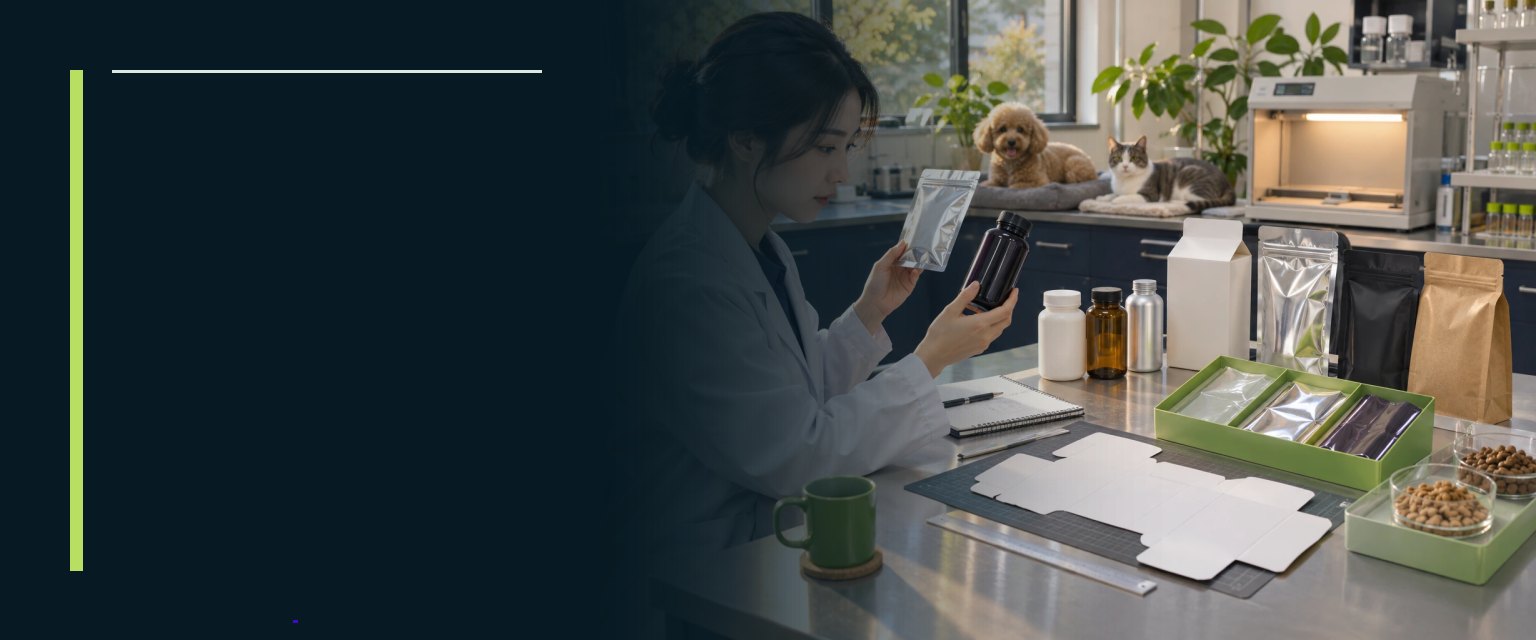
Put where damaging light exposure can occur at the centre of the brief
A credible brief separates what is already decided from what still needs formulation, testing or market review. Start with the use case rather than the ingredient trend. State the target animal, feeding routine, destination and where damaging light exposure can occur. For protect light-sensitive ingredients in retail packaging, these details decide what can be assessed and quoted.
Record assumptions as assumptions
Keep a visible line between available evidence and planned evidence. If measured material properties and stability data affects the answer, state which part is being checked and avoid turning the reference name into a marketing badge.
Ask for evidence that answers this exact question
Request container transmission, secondary pack and distribution conditions in a format that preserves method, units, sample identity and date. Evidence becomes reusable when those details travel with the result.
Read documents in their proper role
Read specifications forward and COAs backward: the first sets the intended boundary, the second must trace to the tested lot. Supporting references such as measured material properties and stability data explain context but do not release a batch.
Connect the formula to use, packaging and storage
Review the formula in the package and the package in the distribution route. A technically suitable ingredient can still create an impractical unit or an unstable opened pack.
Test the likely failure point
The project file should name using an amber color as the only evidence of protection as a scenario to examine. Choose a check that resembles the actual formula, packaging and route. Generic assurances cannot replace that exercise.
Carry the decision into quotation and release
The quotation should name one formula, serving, format, primary pack, retail pack, language set and quantity. Sampling, testing, freight and destination documents belong on separate lines until their scope is confirmed.
Questions for the production discussion
Before closing the review, ask which decision can be approved, which needs evidence and which sits with the buyer. Put the owner and date beside where damaging light exposure can occur so a later version does not inherit an old assumption.
A useful enquiry includes
- Define where damaging light exposure can occur for one product version
- Request container transmission, secondary pack and distribution conditions
- Avoid using an amber color as the only evidence of protection
- Review the decision against measured material properties and stability data
Business guidance for developing pet nutrition products. Individual feeding and health questions require veterinary advice.